
Couples-Focused Divorce Mediation
All Mediation Sessions are Conducted Virtually, for Your Comfort & Convenience
You've tried to save your marriage, but you've both decided that, at this point, it is in everyone's best interests to dissolve it.
Debra Macleod, BA, JD is a divorce and marital mediator with over 20 years of experience helping couples communicate and treat their marriage and family life with dignity, even if those things are changing.
Her approach to separation and divorce mediation is uniquely couples-focused, as her own husband, Don Macleod, often co-mediates sessions.
This couple-to-couple dynamic can be very useful during divorce mediation consultations. It can foster an atmosphere of respect, understanding and collaboration, while making both spouses feel more comfortable and reducing the risk of perceived bias due to gender.
About Divorce Mediation
Even if you are separating, you still know your life - your kids, your preferences, your priorities and your deal-breakers - better than anyone, including a judge. If you are able to communicate respectfully and collaboratively with your spouse toward a common goal, it is far more likely that both of you will be happy with the outcome of your divorce by choosing mediation... or at least happier than you would have been had a judge decided the terms of your divorce. Court decisions can be notoriously unpredictable, and often result in a situation where no one gets what they want. Mediation, on the other hand, is a collaborative process that strives for the "win-win." It is typically much quicker, less costly and far less antagonistic than court proceedings. Indeed, one of the goals of divorce mediation is to ensure that the divorce is as amicable as possible under the circumstances, something that the courts simply cannot prioritize in the same way. How you negotiate this separation and change in your life will have long-lasting, far-reaching implications in your life and the lives of your children.
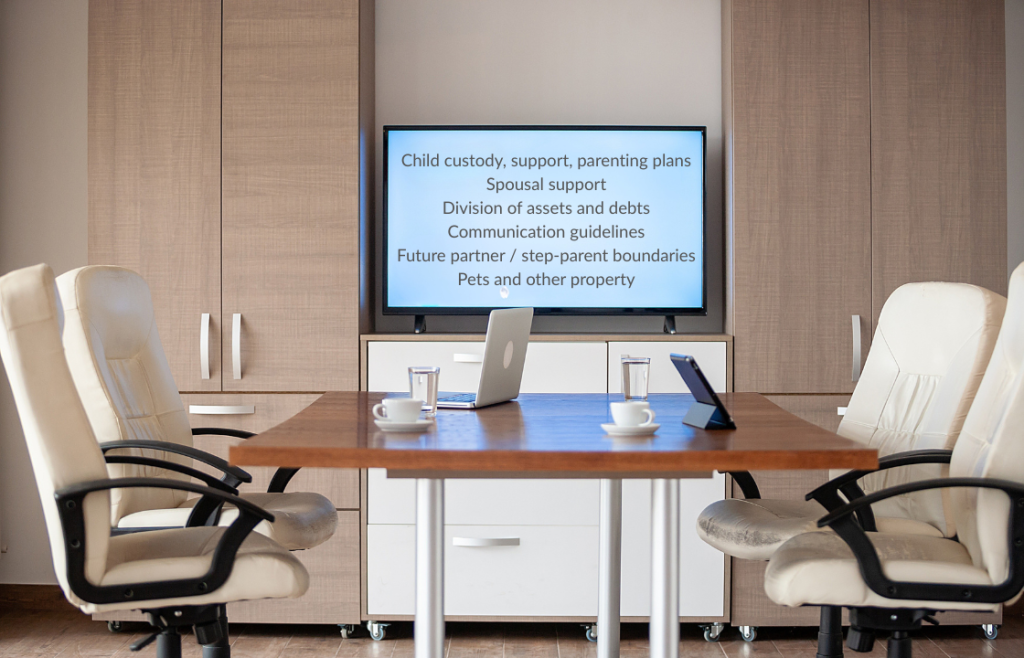
Divorce mediation uses a neutral third-party to facilitate communication, negotiation and informal agreement between two separating individuals. Any agreements you reach during mediation (i.e. regarding child custody and parenting plans, spousal support, division of assets, debt management, pets and other property, etc.) must then be brought to your respective lawyers to advise on and legally formalize.
Who Should and Who Shouldn't Use Mediation?
While divorce mediation is generally preferred by people and by the courts, there are higher conflict or more complex situations where it is inadvisable. For example, it is not suitable in cases of abuse or intimidation, or in situations where one spouse feels they cannot reasonably and safely assert themselves. Mediation is also not recommended in situations of substance abuse, in situations of unusually complicated (or perhaps undisclosed) assets or debts, or where one spouse is unwilling to fully participate in the process (whether due to a higher conflict nature or an enduring hope to save the marriage).
Will You Have One or Two Mediators Participating?
Whether you only have Debra Macleod, BA, JD as your mediator, or whether Don Macleod co-mediates, is generally up to the separating spouses. There may also be cases where Debra advises against the presence of co-mediators. This is an option that may or may not be right for you and will be discussed and decided well in advance.
How to Start the Process
Because divorce mediation requires special consent and collaboration, we ask that you reach out individually to begin the process.
Sorry, we are not currently accepting new divorce mediation clients.