

Now accepting clients for our phone consult waitlist. Visit the phone consults page.
My Spouse Won't End the Affair. Now What?
Discreet, practical strategy for the betrayed spouse who needs to understand what's happening — and get ahead of it.

Most people picture a cheating spouse who gets caught and immediately falls apart with guilt. Tears. Apologies. "It meant nothing, I'll never speak to them again."
That's not what's happening in your house.
Instead, you're getting the locked phone. The deleted texts. The "I need space to figure out my feelings." The refusal to give you a straight answer about whether it's really over. Maybe your spouse isn't even hiding it anymore — they're openly still in contact, still "unsure," still leaving you to live in limbo while they decide between you and someone else.
If that's your situation, you're not dealing with an ordinary affair. You're dealing with a stubborn affair — and it calls for a different kind of response than most advice out there gives you.
Why Won't They Just End It?
There's rarely one single reason. In practice, a spouse who won't end an affair or an inappropriate "friendship" is usually driven by some combination of:
· Long-standing resentment or feeling unloved in the marriage
· Genuine (if temporary) infatuation with the affair partner
· The thrill of being wanted by two people at once
· A midlife crisis dressed up as a love story
· Simple unwillingness to give up something that feels good, regardless of the cost to you
None of these reasons make the behavior acceptable. But understanding which one (or ones) is driving your spouse's behavior changes how you should respond to it. Generic advice — "just give it time," "keep telling them how much it hurts" — assumes a cooperative, remorseful spouse. It falls apart against a resistant or manipulative one.
The Advice That Backfires
If you've been begging, pleading, or asking your spouse a dozen versions of "Are you with them right now? Are you thinking about them? Is this over?" — you already know how badly that goes.
Living in that kind of uncertainty doesn't just hurt. It costs you something real: your dignity, your leverage, and often your spouse's respect. Few people do well trying to compete with an affair partner for their own spouse's attention. And few marriages are saved by a betrayed spouse who negotiates from a position of desperation.
This is exactly why "just give it time" is such common — and such poor — advice. Many counselors and coaches default to it not because it works, but because they aren't trained to handle a spouse who is resistant, defensive, or outright unwilling to end things. It's a hard case. Not everyone knows what to do with it.
This Isn't Therapy. It's Strategy.
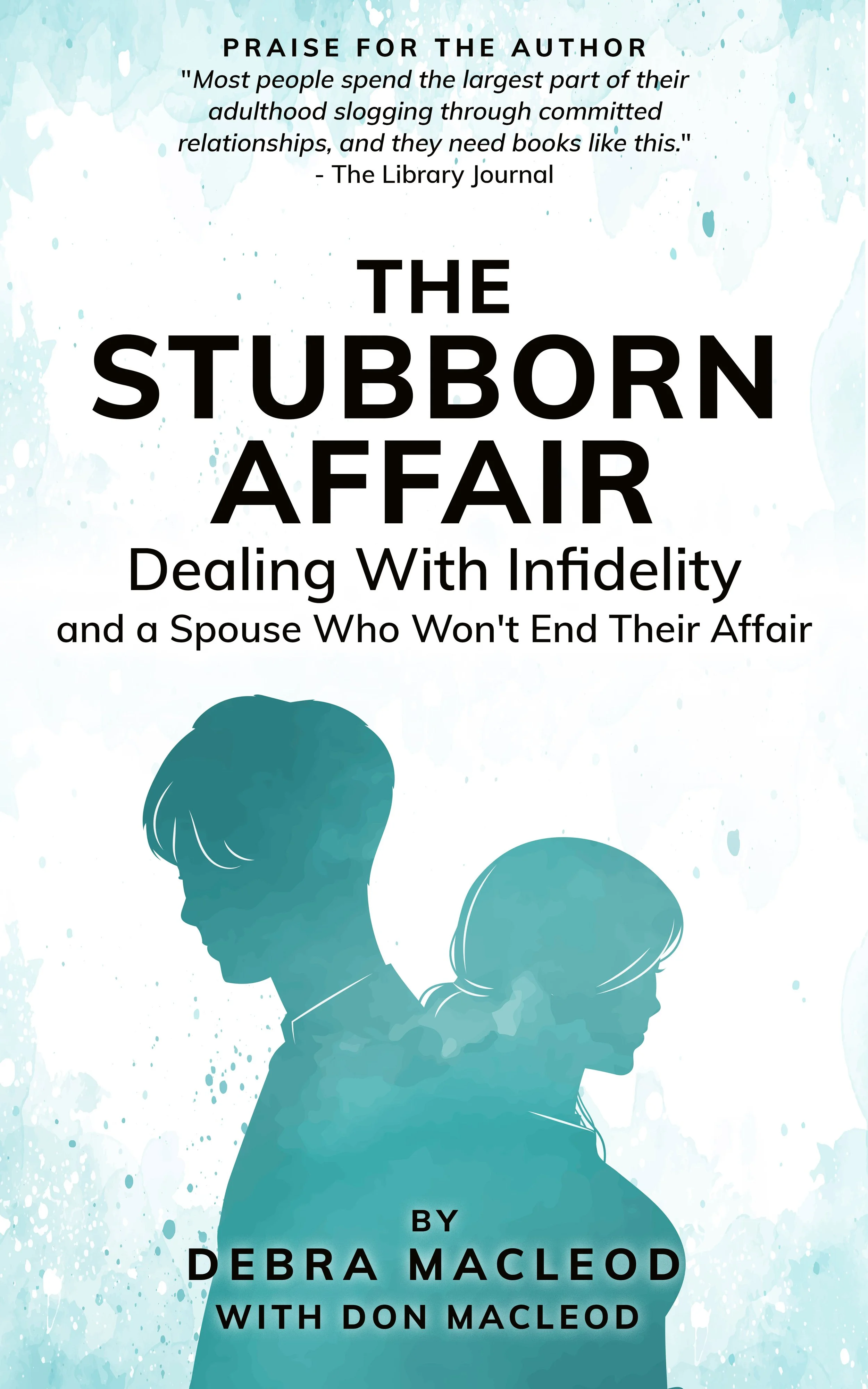
The Stubborn Affair: Dealing With Infidelity and a Spouse Who Won't End Their Affair is not a workbook on healing your feelings, and it's not couples therapy in book form. It's a strategic field guide, written specifically for the betrayed spouse, for one purpose: helping you manage this crisis with clarity and control instead of chaos and desperation.
It's built for the reality many betrayed spouses actually face — a partner who is:
· Still in some form of contact with the affair partner, secretly or openly
· Unwilling to give a straight answer about ending it
· Minimizing, deflecting, or turning the conversation back on you
· Claiming they "don't know what they want"
· Refusing to be transparent about their phone, whereabouts, or time
· Protecting an emotionally-charged "friendship" that never technically became physical
If any of that sounds familiar, this book was written for exactly this moment.
What You'll Actually Get From It
The book walks you through the entire arc — from discovery to recovery — with practical, do-this-not-that direction, including:
· How to decode your spouse's behavior, including the subtle manipulations that keep you off balance (stonewalling, unfair self-focus, minimizing your pain, refusing reasonable requests)
· How to respond when they won't end it — the specific intractable situation most resources won't touch
· What to do about "just friends" relationships that have crossed a line, since these can be just as corrosive as a full affair
· How to handle a relapse or reconnection if your spouse claims it's over but circles back
· How to reclaim your position in the marriage from one of powerlessness to one of clarity and purpose
It doesn't promise your spouse will change. It gives you a way to act — deliberately, with dignity — regardless of what they do next.
Read It Without Anyone Knowing
You don't need this sitting on a nightstand or a bookshelf where it can be found and misread as a threat or an ultimatum before you're ready.
The Stubborn Affair is available on Google Play Books as both an ebook and an audiobook, so you can read or listen on your own phone, on your own time — during a commute, on a walk, in bed after your spouse is asleep. No one has to know you're building a plan until you're ready to use it.
You Have More Power Than You Think
Right now it might feel like your life is on hold while your spouse decides what they want. It doesn't have to stay that way.
Understanding why your spouse is behaving this way — and knowing exactly how to respond to it — is how you take your power back. Not through begging. Not through waiting. Through a clear, deliberate strategy built for a situation most advice doesn't know how to handle.
Get The Stubborn Affair on Google Play Books today — as an ebook or audiobook — and start managing this crisis on your terms.
Marriage SOS partners with Google Play Books. Download the free app and listen to the audiobook or read the ebook on whatever device you’re on.

The S.I.G.N.A.L. Protocol™ Overlay
for The Stubborn Affair: Dealing With Infidelity and a Spouse Who Won’t End Their Affair
Using the Protocol: S.I.G.N.A.L. is designed to sit alongside the core guidance in The Stubborn Affair, not replace it. While the book gives you the strategy or “Master Plan” for saving your marriage, S.I.G.N.A.L. is the lens you keep on during every interaction, so that each word and action you send is one that actually moves you toward repair instead of away from it.
After you have completed the book, including the Q&A’s at the end of each section, review the overlay. Remind yourself of key concepts and add to your master plan by incorporating the proper “signals.”
This approach offers an intelligent, pragmatic and meticulous way to approach conflict. Below, you’ll find a recap of the six pillars of the protocol, followed by the customized overlay for the book.

The S.I.G.N.A.L. Protocol™
Every marriage is a live exchange of signals — the words you choose, the tone underneath them, the timing of your silence, the set of your shoulders when you walk in the door. Your spouse is reading these constantly, usually without knowing it, and reacting to what they pick up. The S.I.G.N.A.L. Protocol is a six-part discipline for becoming fluent in that exchange — so that instead of broadcasting panic, resentment, or defense, you broadcast the kind of steadiness that makes real repair possible.
This isn't a script. It's a way of paying attention.
S — Signal Auditing
Know what you're actually putting out before you try to change what's coming back.
Most people in a struggling marriage are fluent in their spouse's flaws and half-blind to their own transmission. Before anything else shifts, you have to audit your own broadcast — the tone under your words, the message in your posture, the story your reactions are telling.
The Goal: Trade reflexive behavior for responsive, intentional communication.
The Skill: Build the self-awareness to catch your own signal in real time, and enough composure in your presence that your spouse's defenses have less to react against.
I — Intentional Incongruity
Stop feeding the script your spouse expects.
A difficult spouse has a prediction running in the background of every interaction with you — they expect the anger, the pleading, or the retreat, because that's the pattern that's played out a hundred times before. That prediction is what keeps the conflict cycle running on autopilot. Break the pattern, and you break the autopilot.
The Goal: Introduce a moment of genuine surprise — what psychologists call cognitive dissonance — that interrupts a withdrawing spouse's autopilot and forces them to actually look at you again, rather than the story they've built about you.
The Skill: Respond in ways that don't match the familiar conflict script — not to manipulate, but to become genuinely unpredictable in your composure.
G — Grounded Presence
Be the calm the relationship doesn't currently have.
A marriage in crisis is already unstable. If you match that instability — reactive, anxious, escalating — there's nothing left standing. Someone has to be the floor.
The Goal: Become what family systems theory calls the non-anxious presence — the person whose steadiness quietly signals safety to your spouse's nervous system, even mid-conflict.
The Skill: Concrete anchoring techniques, physical and emotional, that let you stay regulated and visibly "in control" of yourself, not of them.
N — Neutralizing the Alarm
Learn to recognize a trigger before it detonates.
In high-conflict marriages, certain words or moments function like an alarm — designed, consciously or not, to provoke a reaction and launch a familiar fight. Recognizing the alarm the instant it sounds is the difference between a conversation and a blowup.
The Goal: Defuse the alarm before it escalates, through self-control and pattern recognition rather than avoidance or suppression.
The Skill: De-escalation tools — anticipating known triggers, recalling what's worked before, and choosing your next move deliberately instead of reflexively.
A — Active Attunement
Hear what's underneath what's being said.
Anger is rarely just anger — it's often embarrassment wearing armor. Silence is often fear wearing a mask. To lead a marriage back from crisis, you have to read the signal beneath the signal.
The Goal: Develop real insight into what your spouse is actually communicating, not just what they're saying.
The Skill: Signal-naming — the practice of identifying your spouse's specific emotional triggers so you can recognize, manage, and navigate them with precision instead of guesswork.
L — Low-Frequency Gestures
Rebuild trust in small, steady signals — not grand ones.
You cannot force connection back into a relationship, and a spouse who's pulled away will often experience a big gesture as pressure, not love. Trust isn't rebuilt with a single grand signal — it's rebuilt the way it was lost: repetition, in small moments, over time.
The Goal: Re-establish warmth and commitment through quiet, low-pressure gestures your spouse can receive without feeling cornered.
The Skill: Consistency over intensity — small, repeated signals of care that rebuild the emotional foundation brick by brick.
Putting The S.I.G.N.A.L. Protocol™ to Use After Reading The Stubborn Affair
When a spouse is in a "stubborn affair," they are living in a fantasy world. They view the affair partner as pleasant and the marriage as pain. To break this cycle, you must stop broadcasting the signals that reinforce their fantasy.
Use these four specific overlays after you’ve read The Stubborn Affair Along (during your “review read”):
Overlay 1: The Surveillance Blackout. The Pillar: S – Signal Auditing
·When to use it: Use during content that focuses on discovery, monitoring or acting like a detective.
·The Tactical Shift: The book discusses the damage of constant checking. The protocol provides the alternative: The Surveillance Blackout. Audit your signal to remove all checking-up / checking in behavior. Stop the questioning and the phone-tracking.
Before every interaction, do a Signal Audit. Ask yourself: "Am I broadcasting a signal of 'Monitoring' (where were you?) or 'Freedom' (I'm busy with my own life)?"
·The Result: When you audit your signal and remove the policing element, when you stop the detective work and surveillance, you force your spouse to sit with their behavior and guilt instead of your behavior.
Overlay 2: The “Grounded Choice” Signal. The Pillar: I – Intentional Incongruity
·When to use it: Use this when the book discusses things like ultimatums or standing your ground.
·The Tactical Shift: Your spouse expects you to either beg them to stay or scream for them to leave (or something in between those!). Instead, use a grounded-choice statement like “I’m not interested in this three-way relationship.” And then do something else.
·The Result: You move from victim to leader. You signal that you might want them, but you don’t need them. This unfamiliar dynamic shifts the power balance and puts you in control.
Overlay 3: The “Blame-Shift” Defense. The Pillar: N – Neutralizing the Alarm
·When to use it: Use this when the book discusses things like defensiveness or blame-shifting (“I wouldn’t have done it if you hadn’t….”). This is often how a spouse sounds the alarm and muddies things with an argument.
·The Tactical Shift: Don’t react to the alarm. Neutralize it. Say something like, “You might’ve felt lonely, but I am focused on myself right now.”
·The Result: When you stop defending yourself (at least when it’s pointless or unwarranted) you signal that you can’t be manipulated.
Overlay 4: Broadcasting the “Safe Shore.” The Pillar: G – Grounded Presence
·When to use it: Use this when the book discusses rebuilding trust
·The Tactical Shift: An affair is full of secrecy, chaos and drama. When it’s time to heal and rebuild, it’s important to broadcast signals of a safe shore - “Our marriage is a safe place to be.”
·The Result: You create a stark contrast between the exhausting and messy fantasy world of the affair (and the anxiety of it), and you present a more peaceful, loving alternative.
Remember: Every signal counts. You can’t talk someone out of a fantasy life.
BUT by overlaying the S.I.G.N.A.L. Protocol™ over the already comprehensive content in The Stubborn Affair, you can change the environment so the fantasy loses its power and appeal.