
10 Things Your Cheating Spouse Doesn’t Want You to Know (And What to Do About It)
Discovering infidelity doesn't just break your heart — it hijacks your ability to think clearly. One moment you're reeling from the discovery, the next you're trying to decode every word, excuse, and half-answer your spouse gives you. Are they finally being honest? Or still managing you?
Here's the truth: some unfaithful spouses want to rebuild the marriage, and some just want to survive the fallout with as little damage to themselves as possible. Knowing the difference is the single most important skill you can develop right now.
Sincere spouses tend to look the same. They answer questions instead of dodging them. They take ownership without minimizing what they did. They show real remorse, not performed remorse. They cut off the affair partner completely and stay transparent — with their phone, their schedule, their whereabouts — because they understand trust has to be re-earned through action, not promises.
Insincere spouses look different, even if they say all the right words. They're not focused on you or the marriage. They're focused on managing the crisis, minimizing consequences, and getting back to normal life as fast as possible — with the least personal cost to themselves.
Below are ten things a self-protective, unfaithful spouse hopes you never figure out.
1. They know exactly what they did — and that it was a betrayal
When they debate semantics ("I only sent a photo, I didn't sleep with anyone" or "Texting isn't cheating"), they're not confused about right and wrong. They're stalling. Arguing over definitions is a deflection tactic, not a misunderstanding — it's designed to pull you into a technical debate so you stop looking at the actual betrayal.
2. The story isn't finished yet
Phrases like "it only happened once," "we never met in person," or "we always used protection" often turn out to be incomplete — or false. It's extremely common for new details to surface in waves, weeks or even months after the affair is first discovered. If your gut says there's more, there probably is.
3. The secrecy itself may have been part of the appeal
Not every affair is only about the other person. For some unfaithful spouses, the secrecy, the risk, and the "forbidden" nature of it added its own thrill. That's an uncomfortable truth, but an important one to understand if you're trying to make sense of why.
4. A guarded phone is a red flag, not an overreaction
If asking to see their phone gets you labeled "controlling" or "paranoid" — especially in the early aftermath of discovery — pay attention. A spouse with nothing left to hide rarely fights this hard to protect their privacy.
5. They're building a case that this is your fault
Statements like "I wouldn't have cheated if you were more available" or "You drove me to this" are blame-shifting, plain and simple. Yes, marriages can have real, pre-existing problems. But problems in a marriage don't remove someone's ability to make choices. Nobody is forced into secrecy and betrayal — they choose it, and they alone are responsible for that choice.
6. They want the conversation to be over — for their comfort, not your healing
"Get over it already" or "I said I was sorry, what more do you want?" isn't remorse. It's impatience. It signals they're unwilling to sit in the discomfort long enough to actually rebuild trust — they just want the topic closed so life goes back to normal.
7. "It just happened" is never true
Affairs don't happen by accident. Every step — the first flirtation, the first secret, the first lie — was a decision. Comments like "it's impossible to be faithful to one person" aren't insight, they're justification. Plenty of people build long, imperfect, devoted marriages. It comes down to choices, not impossibility.
8. Trust is earned back through actions, not declarations
"You just have to trust me" is not something you owe anyone, especially someone who has already proven capable of sustained secrecy. Trust isn't rebuilt with a sentence. It's rebuilt slowly, through consistent, verifiable behavior over time.
9. History has a way of repeating
It's not guaranteed that "once a cheater, always a cheater" — but infidelity does frequently become a pattern, for one or both partners, when the underlying issues are never actually addressed.
10. "I don't know why I did it" is almost never the whole truth
Everyone who cheats knows why, even if the reason is uncomfortable to say out loud. It might be something they'd call deep ("I convinced myself I was in love") or something shallow ("it was exciting and I didn't think I'd get caught"). Either way — they know. "I don't know" is usually a way to avoid accountability, not a genuine gap in self-awareness.
Does this mean your marriage is doomed?
No — and this is critical to understand. Even a spouse who is genuinely trying to save the marriage can show some of these behaviors. A sincere partner might say "I don't know why" simply to avoid inflicting more pain. They might minimize the details to keep the peace. They might resist showing you their phone out of fear the affair partner is still reaching out, even after being told to stop.
Context matters. Frequency matters. Attitude matters.
What separates a spouse who's fighting for the marriage from one who's just protecting themselves is usually visible in the pattern — especially when these behaviors are persistent, repeated, or delivered with defensiveness and hostility rather than humility.
You can't out-think a spouse who's still managing the narrative — but you can out-strategize them
Here's what most betrayed spouses don't realize until it's too late: understanding your spouse's behavior is only half the battle. The other half is knowing exactly how to respond to it — what to say, what not to say, what to ask for, and what boundaries actually work to shift a resistant spouse's behavior.
Winging it rarely works. Reacting emotionally, however justified, often gives an unmotivated spouse more excuses, not more accountability.
That's exactly why we wrote The Stubborn Affair: Dealing with Infidelity and a Spouse Who Won't End Their Affair.
This isn't a therapy book, and it isn't a book of vague affirmations about "healing your heart." It's a strategic playbook — built specifically for the betrayed spouse who is dealing with a partner who is stonewalling, minimizing, deflecting, or refusing to fully end the affair. It gives you:
· A clear framework for decoding what your spouse's specific words and behaviors actually mean
· Real, practical scripts and strategies for confronting denial, blame-shifting, and stalling
· A step-by-step approach for setting boundaries that actually produce change — not just conflict
· Guidance for regaining leverage and clarity when you feel like you're the only one fighting for your marriage
The Stubborn Affair is available right now as both an ebook and audiobook on Google Play Books — which means you can read or listen to it completely discreetly, on your own phone, on your own time, without anyone else knowing. Whether you're commuting, doing chores, or lying awake at 2 a.m. running through the same questions again, you can start building your strategy immediately.
You don't have to keep guessing whether your spouse is telling you the truth. You don't have to keep absorbing blame that was never yours to carry. And you don't have to face a stubborn, uncooperative spouse without a plan.
Get The Stubborn Affair today on Google Play Books and start turning confusion into a clear, strategic path forward.
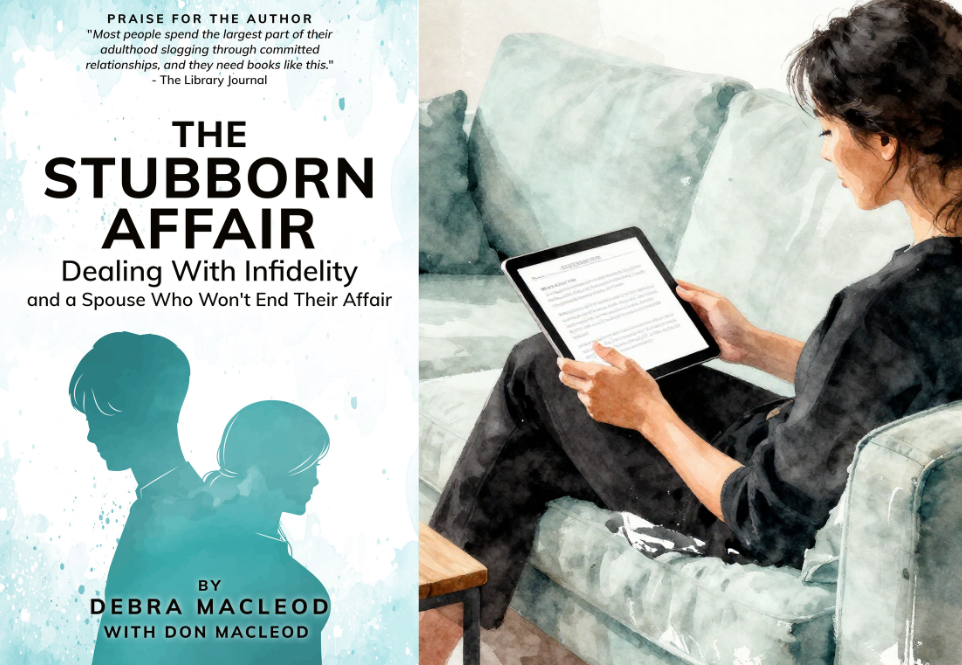
Marriage SOS partners with Google Play Books. Download the free app and listen to the audiobook or read the ebook on whatever device you’re on, starting right now.